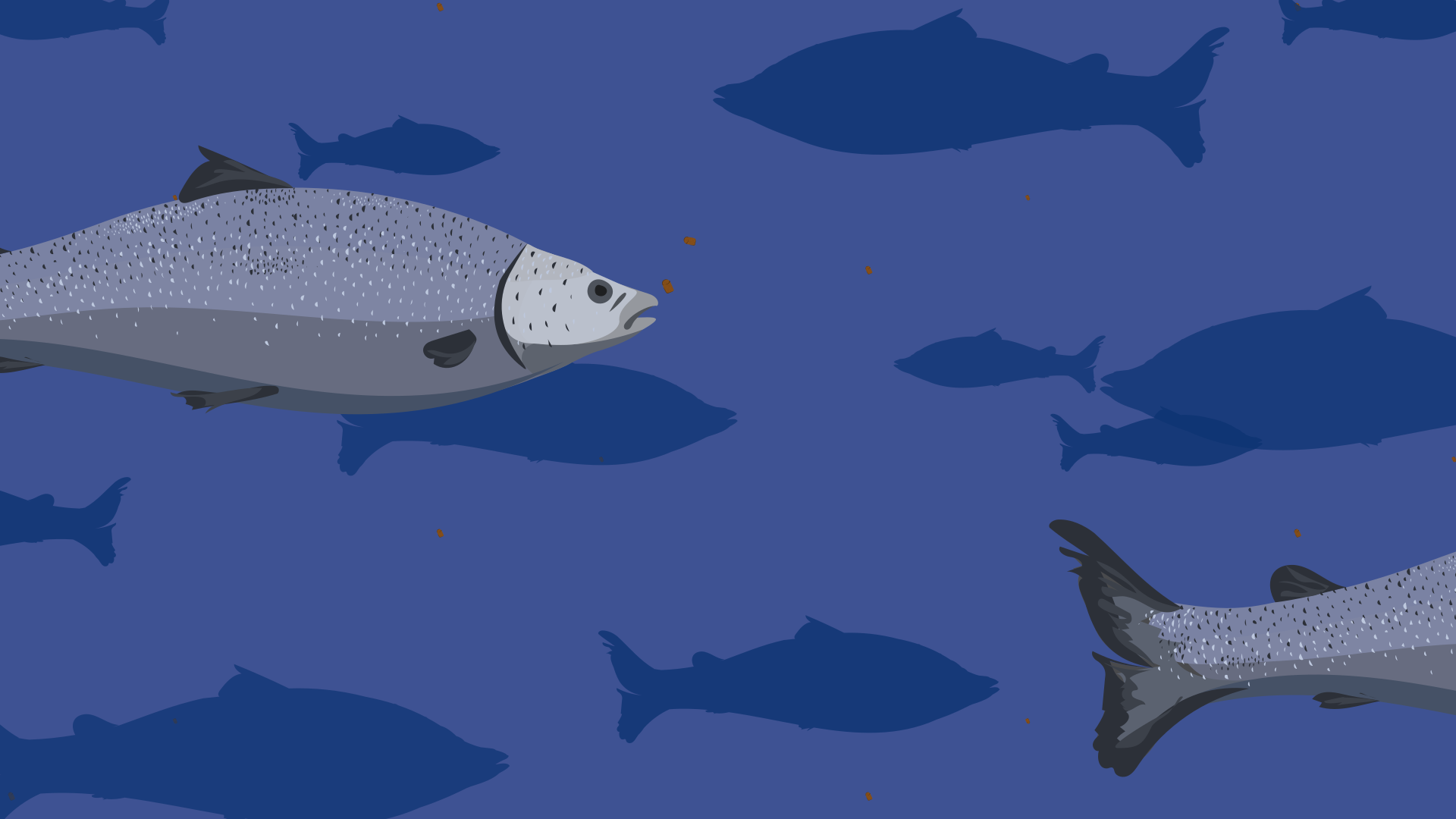
Feeding the fish
Illustration: Alicia Harris
Feeding the fish
- Published
Salmon are farmed in the sea, but feeding them takes a whole lot of land.
- The modern-day farmed salmon’s diet is almost three-quarters cultivated land plants.
- New research from Sunstone Institute reveals that in Norway alone, it takes 860,000 football pitches of cultivated land to feed Norwegian farmed salmon for a year.
- Most of the land used to grow Norway's salmon feed is abroad. If the land was in Norway, it would amount to more than two-thirds of the country's total agricultural area.
- Journalist
- Lou Luddington
- Data Scientist
- Carter Brown
- Interactive Designer
- Alicia Harris
- Editor
- Ingerid Salvesen
Picture a salmon farm anywhere in the world, it could be in a Chilean sound, a Scottish sea loch, a Norwegian fjord or an inlet along Canada’s Pacific coast. The floating circular pens, each the length of an Olympic swimming pool, are grouped in clusters of eight to ten and house thousands of fish. The area occupied by the pens is a swathe of sea that amounts to a few hectares. It is tangible and visible. This area is measured, licensed and regulated by the country authorities. But the reach of salmon farming extends to areas we don’t see, made by ingredients in the salmon’s feed pellets.
Beyond the floating pens, land is used to grow crops, and ocean area is fished for ingredients that go into the pellets. Together they create a sprawling track far larger than that of the pens. New research from Sunstone Institute reveals that in Norway alone, it takes 860,000 football pitches of cultivated land to feed Norwegian farmed salmon for a year. It also shows that most of this land is abroad but if it was in Norway, it would occupy around 62% of the country's total agricultural area.
Sunstone's extrapolation suggests the total land area for all the salmon produced in one year across the globe would amount to 1.6 million football pitches.
The wild fish portion of salmon feed is accounted for because of the scale required by the salmon industry. Millions of tonnes of wild-caught fish are needed to feed the captive salmon every year. To protect marine ecosystems from overfishing, fishing quotas and sustainable feed certification schemes set a limit on how much wildfish goes into the pellets. It is measured and regulated. But the cropland used to grow the plant ingredients is not.
Often situated far away in other continents, the country of origin is recorded, but the extent of this land is not routinely measured by any authority, because the data required to do so is either reported infrequently, or not at all. When costs are invisible they can neither be managed nor regulated.

Salmon farms inhabit a visible area in the sea. What we don’t see is the area associated with growing the land crops to feed the fish. Photo: Getty Images
Farmed salmon live in fish pens.

Nutrient-dense pellets are carefully formulated to maximise growth of farmed salmon. Photo: Getty Images/Mint Images RF
But their feed composition has changed from mainly wild fish to...

Soya beans growing on agricultural land in Brazil, a major ingredient of farmed salmon feed. Photo: Getty Images
plant-based ingredients, such as soya, which are grown on land.
Food, glorious fish food
Salmon farms are familiar real estate in Norway’s fjords. There are 995 sea farms spread around the coast rearing 400 million salmon every year. The space a sea farm inhabits and the mass of fish in residence is measured and reported by the industry and regulated through licensing by the government. All these captive fish need feeding. Their food is a carefully formulated pellet produced from high quality ingredients traded in a global market.
Norway publishes more feed data than any other farmed salmon producer worldwide. The sustainability of the feed and the end-of-line salmon fillet that ends up on your plate are determined by which ingredients are used, how they are sourced, and the quantity used relative to the amount of salmon produced.
Feed data have been published for 2010, 2012, 2016 and most recently, for 2020 by scientists from the Norwegian Institute of Food, Fisheries and Aquaculture Research (Nofima). The latest analysis (opens in a new tab)compiles information from the four largest feed companies operating in Norway (BioMar, Cargill, Mowi Feed and Skretting) and details feed pellet ingredients, origin and certification of the ingredients, and the amount of salmon produced in that year.
In 2020 just less than 2 million tonnes of feed ingredients were used to produce around 1.5 million tonnes of salmon, a ratio of approximately 1.35 kg of feed per kg of fish.
The feed was composed of roughly 73% vegetable ingredients, 22% marine ingredients, 4% micro ingredients and less than 1% novel and other ingredients.
These proportions have changed over the years. Historically, the feed relied on wild-caught fish to match the salmon’s natural carnivorous diet. Back in 1990 (opens in a new tab) the pellet blend was predominantly fish meal and fish oils from wild caught fish and only 10% of vegetable origin. But overfishing of wild stocks, demands for higher environmental sustainability and changes in availability and price of ingredients, meant the salmon’s diet shifted to a more plant based formulation in the 30 years that followed. Various international certification schemes now regulate the sustainability of ingredients used in the feed, for example the Aquaculture Stewardship Council (ASC) Feed Standard (opens in a new tab) and the Global Seafood Alliance's Best Aquaculture Practices (BAP) framework. (opens in a new tab)
Norway's land account
The modern-day farmed salmon’s diet is almost three-quarters cultivated land plants. These amount to an eclectic list of 14 different ingredients that includes soya protein concentrate, rapeseed oil, wheat, guar protein, peas, beans and linseed oil. These plant-powered salmon gain 1 kg of body mass from roughly 1.35 kg of feed. Multiply this up to the scale of the salmon industry and feeding the fish requires an abundance of crops grown on a sizeable expanse of land.
Sunstone Institute research estimates that roughly 6,100 sq km of cropland is occupied per year to grow the ingredients in Norwegian salmon feed. This is the equivalent of around eight times the area of New York city or 860,000 football pitches. The space occupied by a sea farm we catch sight of as we drive along the coast, is around 65 times smaller. For every adult salmon swimming in those pens, roughly two car parking spaces of cultivated land is required to feed it. On the current trajectory of an increasingly plant-based diet and an expanding salmon industry, this area is likely to rise in the future.
To be clear, this feed crop area is land in use for a year to grow the crops, not land cleared in order to grow the crops. It is not a measure of deforestation. The terrestrial environmental challenges closely tied to the salmon industry, including agricultural deforestation, fertilizer runoff, and land-use carbon emissions is a broader story told elsewhere.


